


Development boards, such as NXP’s FRDM platform for MCX A series MCUs, are revolutionizing embedded systems by integrating components for prototyping and innovation in the IoT landscape. These technologies streamline development, enhance flexibility, and reduce costs, enabling greater focus on software development while addressing complex challenges.
Development boards are an integral part of developing and testing for embedded systems. As more devices in industrial facilities, the home, and buildings become connected to the Internet of Things (IoT), the need for streamlined and cost-efficient ways to design and innovate new technology has skyrocketed.
It is no secret that spending time testing connections on a breadboard, or worse, soldering, could cause massive headaches and undue stress when a developer’s time could be better spent coding. Electronics development has evolved significantly, from the complexities of single-board computers to the user-friendly convenience of development boards. Development boards have integrated essential components like microcontrollers, power supplies, and pre-programmed functionalities onto a single, compact platform. This shift has democratized electronics development, making it faster, more affordable, and easier for a wider range of creators to learn. To further boost developer efficiency, NXP’s FRDM development boards [1] as shown in Figure 1 come with an MCX MCU, a standard form factor and headers, easy access to the MCU’s I/Os, and an on-board debugger, which makes it ready to use.
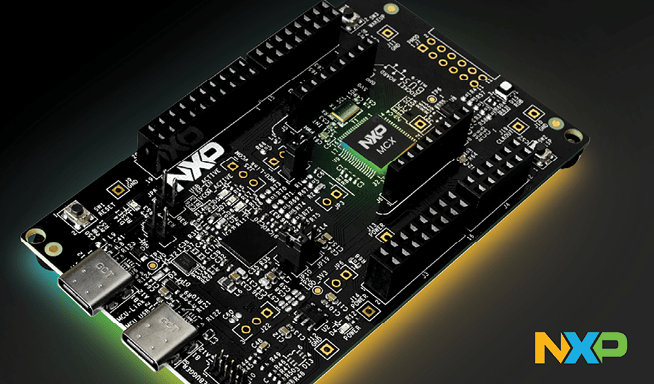
NXP’s FRDM Development boards feature MCX MCUs. (Image source: NXP)
NXP’s MCX portfolio, which includes the MCX A series, is part of the MCUXpresso Developer Experience and has many ready-to-use tools for engineers, such as its MCUXpresso IDE. NXP’s enhanced FRDM boards allow for faster prototyping while also offering flexibility and scalability, not just from MCX A microcontrollers but across the entire MCX portfolio.
DEVELOPER CHALLENGES
Worldwide competition and adaptation are key factors in creating today’s development board products. Because an increasing number of devices are currently entering the market, they are all fighting for the same customers, and several challenges have arisen as a result. For instance, the supply chain has impacted the availability of products that engineers need for development. As a result, these materials are in high demand and are becoming obsolete. Due to all these uncontrollable factors and the need to stay current in the market, all developers need product migrations and fast development.
This factor makes tools and enabling software an essential part of rapid development and is one area where NXP offers customers added value to the products for both MCUs and MPUs. NXP offers more than just semiconductors; offerings span solutions, proof of concept designs, an integrated developer experience, and highly flexible evaluation boards that enable the industry to keep products coming out of their factories. Additionally, NXP has options to make its MCU portfolio accessible to different developer profiles as shown in Figure 2, from students who are building short-term projects to major corporations that have a wide range of complex requirements and much longer development cycles.
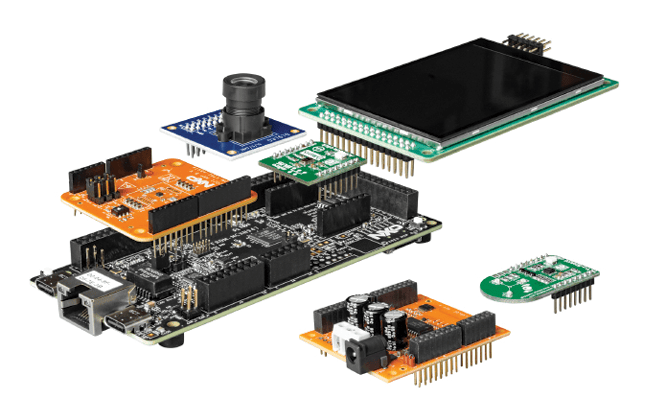
NXP FRDM development boards offer expansion options to meet the requirements of many different profiles. (Image source: NXP)
NXP FRDM PLATFORM
With the release of the MCX A14x and MCX A15x in the MCX A [2] series shown in the Figure 3, it is important to have a development board to streamline innovation with them. The FRDM platform gives developers flexibility and the capability of rapid prototyping. The FRDM boards come standard with an on-board MCU-link debug probe to make debugging code effortless and industry-standard headers that will allow for compatibility with existing devices without the headache of finding special cables or adapters. The ability to plug and play with external components like sensors, motor drives, and more allows developers to skip the hassle of worrying about compatibility with common devices.
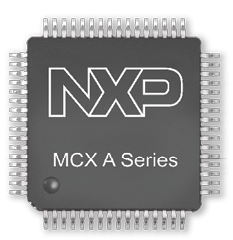
NXP developer boards featureing the MCX A14X and MCX A15X microcontrollers, give developers flexibility for rapid prototyping. (Image source: NXP)
EMPOWERING CREATIVITY
Leading hardware is only half of the battle that engineers face when creating new technology. They must also tackle intricate software and algorithm development, manage ever-growing complexity while making devices more user-friendly, address ethical considerations, and navigate cost and time constraints. Regulatory compliance adds other obstacles, demanding adherence to various safety standards and frameworks.
The MCUXpresso Developer Experience offers tools to jump-start development so that developers can focus on other challenges. This allows developers to spend more time writing software specific to their needs instead of creating their own SDKs and APIs. NXP offers both an Eclipse-based IDE and simple integration with Visual Studio Code via a plugin.
Additionally, the Application Code Hub contains snippets of code developed by NXP’s in-house engineers and experts. Here, developers can see a range of simple and complex uses for the FRDM boards, which removes many of the obstacles that come with starting a new project. The available software packs and demo applications are also easy to import into IDEs.
Continuous integration and deployment are commonplace in modern software design. The MCUXpresso SDK [3] comes with pre-written CMake scripts that can be integrated with an engineer’s preferred development, build, and deployment tools. The entire MCX portfolio can use this tooling, and it gives engineers the freedom to develop and innovate in a method that fits their preferences. The Application Code Hub that NXP offers also gives examples, code snippets, and software kits developed by NXP’s in-house engineers.
The MCUXpresso Developer Experience with the FRDM development platform includes a multitude of expansion boards available on the Expansion Board Hub with drivers compatible with the MCUXpresso SDK. It also includes examples of how to integrate with them and functional and robust debugging tools. The FreeMASTER Run-Time Debugging Tool allows for debugging in real time, monitoring variables while a system is running without intruding, and visualization of data in multiple forms.
ALL-PURPOSE MCU POWER
So, why are developers increasingly turning to all-purpose MCUs for enhanced efficiency in their projects? All-purpose MCUs are versatile chips that offer a multitude of benefits for various applications. Affordable and versatile, they can handle complex projects with diverse functions even on a tight budget. They simplify development by reducing component integration and management, leading to faster time-to-market.
NXP’s new MCX A series, including the MCX A14x and MCX A15x, are excellent all-purpose MCUs for any engineer. They are low-cost, have a minimal footprint, and offer autonomous, low-power peripherals, which help to make the newest innovations accessible to every engineer.
Both the MCX A14x and MCX A15x feature an Arm Cortex-M33 core, with the MCX A14x running at clock speeds up to 48MHz and the MCX A15x running at clock speeds up to 96MHz. The MCX A series comes in many different memory amounts with up to 1MB of flash. Both feature BLDC and PMSM controls and a number of integrated sensor interfaces (MIPI-I3C, I2C, SPI), as shown in the block diagram in Figure 4.
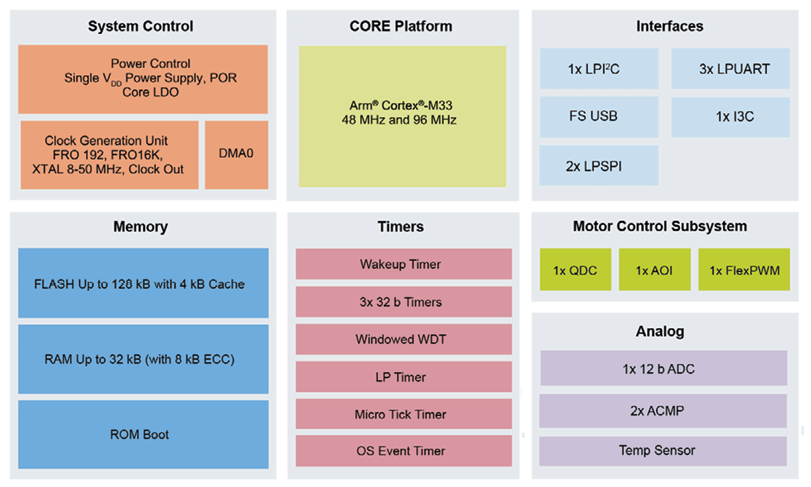
The MCX A series comes in many different memory amounts with up to 1MB of flash. The series also features BLDC and PMSM controls and a number of integrated sensor interfaces (MIPI-I3C, I2C, SPI), as shown in the block diagram (Image source: NXP)
One of the MCX A series’ defining features is the selection of autonomous peripherals that allow for the offloading of tasks from the microcontroller so it can run at a lower frequency and save power. These peripherals include DAC, mixed signals ADC, serial comms with built-in buffers, a programmable data collection range, and FlexPWM.
ENERGY EFFICIENCY
A key capability of the MCX A14x and MCX A15x is that they can operate efficiently with low power. RAM can be retained down to very low-power modes. This allows the MCU to sit idle when not being used and consume very little power without losing data stored in RAM. It also can remain in communication with a sensor or external device and begin running again when a certain signal is received.
Both of the new MCX A series have a low-power cache controller attached to the Arm Cortex-M33 core. Like any CPU cache, it can store data and instructions in a place much closer to the microprocessor and with lower latency than direct memory access. More importantly, when it’s not being used, it can be used as instruction memory.
Low power consumption is an important feature in industries like manufacturing and agriculture, as environmental regulations govern emissions and power usage. An embedded system for monitoring temperature or humidity can run on very little power, with the signal triggering a function based on the measurement.
DEFINING REQUIREMENTS
Developers are receiving a growing list of requirements that they didn’t use to have to stay ahead of competitor devices appearing in the market. Additionally, developers also have the demand to create and implement more value-added features for differentiation. The current trend is toward devices becoming smarter and more secure, which is driven by customer concerns and their desire for more functionality. However, crucially, these developments are also mandated by new cybersecurity legislation. Developers need to adapt quickly to all these new requirements, often in areas where they may have limited experience.
FUTURE OF EMBEDDED DEVELOPMENT
As the landscape of embedded development keeps evolving, all-purpose MCUs and development boards empower engineers to translate their ideas into reality with greater efficiency and reduced complexity. These versatile devices, equipped with advanced features and functionalities, allow developers and engineers to create with no restrictions. NXP’s MCX portfolio [4] is developed with cutting-edge technology and is at the forefront of power-efficient devices for use in all forms of engineering. Explore more of NXP’s MCU offerings [5] to see how you can create with the future in mind and develop technology across a variety of industrial and IoT markets.
RESOURCES
NXP | www.nxp.com
REFERENCES
[1] NXP’s FRDM development boards – https://www.nxp.com/design/design-center/development-boards-and-designs/general-purpose-mcus:FREDEVPLA
[2] MCA microcontrollers – https://www.nxp.com/products/processors-and-microcontrollers/arm-microcontrollers/general-purpose-mcus/mcx-arm-cortex-m/mcx-a-series-microcontrollers:MCX-A-SERIES
[3] MCUXpresso SDK – https://www.nxp.com/design/design-center/software/development-software/mcuxpresso-software-and-tools-:MCUXPRESSO
[4] NXP’s MCX portfolio – https://www.nxp.com/products/processors-and-microcontrollers/arm-microcontrollers/general-purpose-mcus/mcx-arm-cortex-m:MCX-MCUS?tid=vanMCX
[5] NXP’s MCU offerings – https://www.nxp.com/products/processors-and-microcontrollers/arm-microcontrollers/general-purpose-mcus:GENERAL-PURPOSE-MCUS
PUBLISHED IN CIRCUIT CELLAR MAGAZINE • FEBRUARY 2025 #415 – Get a PDF of the issue
Sponsor this Article
Mónica Cid is a product marketing engineer in NXP’s Secure Connected Edge business. She has been with NXP since 2022, starting as a technical marketing engineer for edge processors. Prior to this, she worked as a software developer in the manufacturing industry. She has a bachelor’s degree in artificial intelligence engineering and a master’s degree in project administration. Mónica lives in Guadalajara, Mexico, and is passionate about technology and projects that help make life easier and better for everyone.


